It was 8 a.m. and I was late. Again.
I’d pedaled across campus faster than I should have, backpack bouncing against my shoulder, still tasting the coffee I hadn’t finished. The lecture hall at Arizona State was already buzzing when I got there, backpacks hitting the floor, notebooks opening, that low roar of two hundred students who’d rather be anywhere else at eight in the morning. I locked my bike outside and hustled in still catching my breath. Skipping wasn’t an option. Missing an attendance quiz in Dr. Mendez’s class was one of the fastest ways to wreck your grade, and I needed every point I could get.
I slid into a seat near the back, one of those fold-out desks that never quite fit a notebook right, and was still digging through my bag when I heard him start.
“Let me tell you about the boiling frog.”
Something in how he said it made me look up. Dr. Mendez wasn’t a dramatic guy. He lectured in the same even tone whether he was covering syllabus logistics or the final exam schedule. So when his voice dropped into storytelling mode, actually slowed down, actually paused between sentences, the room quieted in a way it hadn’t all semester. Even the kids in the back row who spent most of class on their laptops looked up.
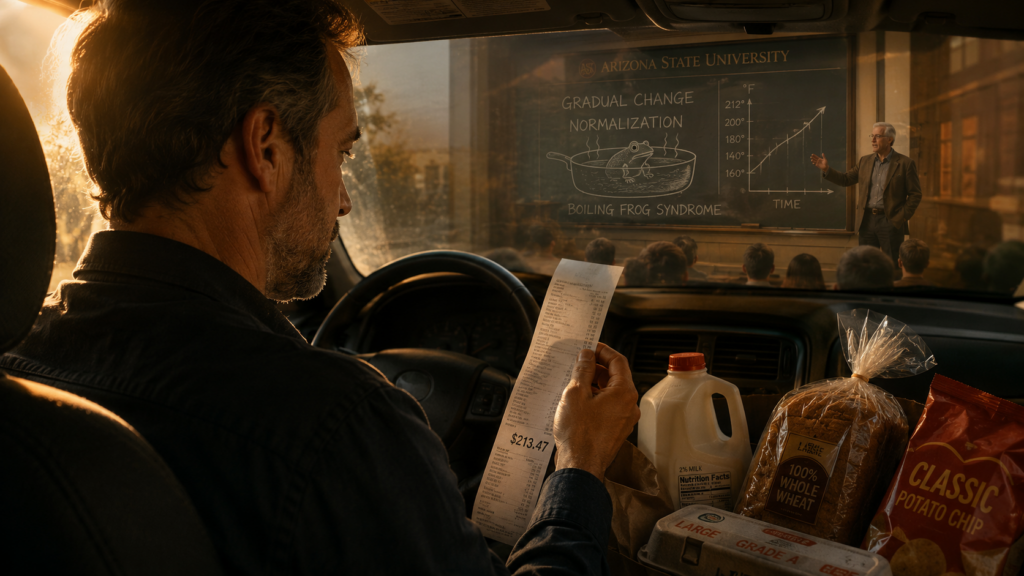
“Imagine a pot of water,” he said, hands moving like he could see it sitting right there on the podium in front of him. “Drop a frog into boiling water, it jumps right out. Instinct. It knows immediately something’s wrong and it gets out.” He let that sit for a second. “But put that same frog in cool water, and slowly, slowly turn up the heat, and it won’t jump. It’ll just keep adjusting. A degree at a time feels like nothing. By the time the water’s actually dangerous, the frog’s stopped noticing the difference between dangerous and normal. It’ll sit there until it’s too late.”
He wasn’t teaching biology. I don’t even remember what the actual class was building toward that day, some unit on organizational behavior or decision-making under uncertainty, the kind of thing that blurs together twenty years later. But the frog stuck around long after the rest of the lecture faded. It’s one of those stories that gets filed away someplace you don’t expect to need it, and then one day you do.
Fast forward to now, and I’m standing at a grocery store checkout, one of those self-checkout screens that beeps at you like it’s judging your choices, staring at a total that says $213.47.
I looked down at the cart. Same stuff I always buy. Milk, bread, eggs, something for dinner, snacks for the kids, nothing that should’ve added up to over two hundred bucks. Nothing had a price tag that made me flinch on its own. It wasn’t like I’d grabbed a steak I couldn’t afford or thrown in something extravagant on impulse. It was subtler than that. Everything was just a little higher than I remembered. Milk that used to be four dollars was five. Bread that used to be three was four fifty. None of it alone was worth complaining about. All of it together was $213.47 for a Tuesday grocery run.
I bagged everything, wheeled the cart out to the car, and sat there for a minute with the receipt still in my hand before I pulled out of the lot. The AC hadn’t caught up yet and the seat was already hot from sitting in the Phoenix sun. It wasn’t really about the groceries, not by the time I was sitting there staring at the total. It was about how slow this kind of thing creeps. Gas. The electric bill in July. The stuff you adjust to a little at a time without ever really noticing, until one day you look up and the water’s too hot and you honestly can’t remember when it stopped feeling normal.
That’s when Dr. Mendez’s voice came back to me, twenty-some years later, sitting in a Fry’s parking lot with a receipt in my hand instead of a notebook.
Because I’ve been sitting in water like that with the book.
For years, working on this memoir has been something I could always keep doing without ever having to finish it. There was always one more chapter to revise, one more line that wasn’t quite right, one more round of notes from Jocelyn to work through. Each fix felt like progress. It let me stay busy on the thing I cared about most without ever having to be brave about it. As long as I was still working on it, I never had to actually send it anywhere and risk somebody telling me no.
That’s the part I don’t love admitting. It was never that I didn’t care enough to query agents. I cared too much. Enough that staying in revision mode, safe, familiar, endlessly fixable, felt a lot better than finding out what the answer might actually be. Rejection was always the hotter water. Revision was the cool water I could sit in forever and call it progress.
But the water wasn’t cooling off. It was just quiet. Some mornings I’d catch myself opening the manuscript for what had to be the fortieth small fix, a comma here, a word swapped there, and realize partway through that I wasn’t editing anymore. I was hiding, one degree at a time, and calling it discipline.
So this year I’m doing the uncomfortable part. Nights, weekends, the hours I’d normally spend checked out on the couch, going instead into the query letter, the agent list, the pitch, all the stuff that has nothing to do with writing a good sentence and everything to do with whether anyone besides me and Jocelyn ever reads this book. It’s the part I’ve been avoiding since the manuscript was actually ready, which, if I’m honest with myself, has been longer than I want to admit.
I don’t know yet if it works. I don’t know if the agents say yes, or if the water cools back down before I get anywhere with it. I just know I finally noticed it was hot. And after twenty years of carrying Dr. Mendez’s frog around without needing it, noticing turned out to be the part I’d been avoiding the longest.
About the Author
Matt Cavallo
Author, keynote speaker, healthcare leader, and storyteller. Twenty years with MS, turned into stories that move readers, audiences, and healthcare leaders alike.