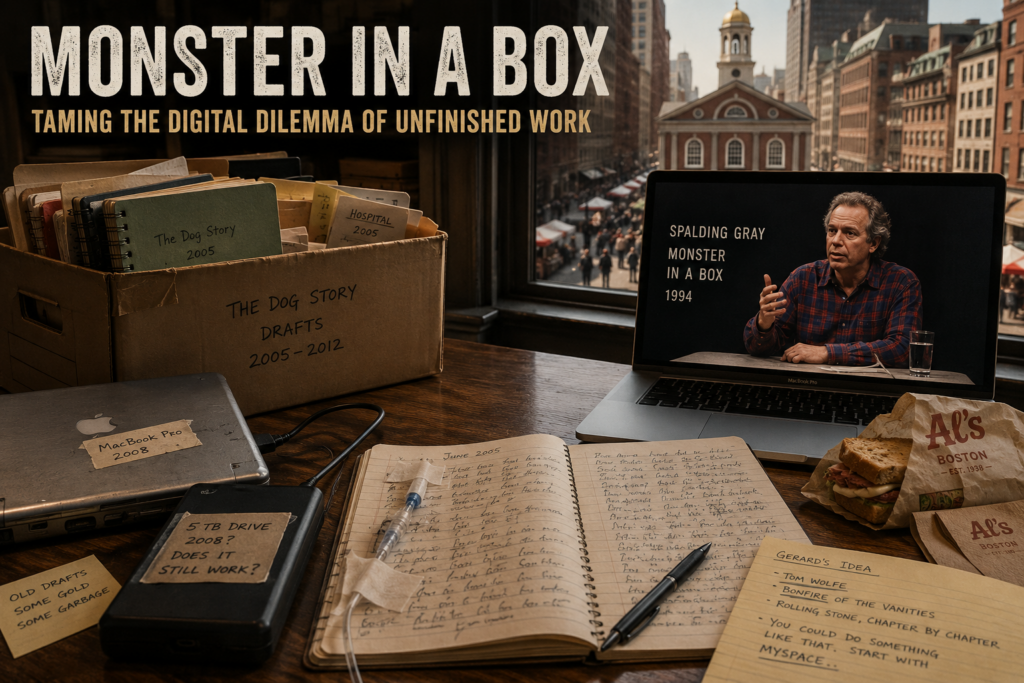
Gerard and I were back at our usual lunch spot, sandwiches from Al’s, the window open to the noise of State Street, when he set his phone down on the desk between us and hit play on a grainy clip of a man in a red and blue checkered shirt sitting alone at a table with a glass of water.
“You need to watch this guy,” he said. “Spalding Gray. Monster in a Box. When I hear you talk, when I read what you write, this is what it reminds me of.”
I didn’t know who Spalding Gray was. Gerard filled me in while the clip played, how Gray built an entire career out of sitting at a table and talking, monologue after monologue, mostly just him and his own life, no props, no set, nothing between him and the audience but a story told straight. Monster in a Box was about the manuscript that had been chasing him for years, a novel he couldn’t finish, that he carried around with him like a physical weight he was strapped to. He talked about it the way you’d talk about a person, this thing that lived in a box and refused to be resolved.
I watched maybe ten minutes of that clip and understood exactly what Gerard meant. Gray wasn’t performing. He was sitting there being specific, being vulnerable, describing his own absurd, terrifying, funny situation in enough detail that you weren’t watching him anymore, you were picturing yourself in it. That’s the only trick I’ve ever known how to do when I talk, whether I’m on a stage or dictating to Claude at my desk with a neck brace on. You don’t tell people how to feel. You put them inside a specific enough moment that they feel it themselves.
And I had my own monster. Not one manuscript in one box, a whole scattered mess of them. An old laptop from 2008 that barely turns on anymore. A five pound external hard drive I haven’t plugged in for over a decade, sitting in a drawer, daring me to find out if it still works. And underneath all of that, older than any of it, a green spiral notebook from 2005 that I filled with an IV taped into my arm, writing because there wasn’t much else I could do from that hospital bed. That notebook became the bones of the original Dog Story, the version I self-published in 2012 and sold over 30,000 copies of, one folding table at a time, at speaking engagements around the country.
For years I thought that was the finished version. Then COVID took the stage away, and my day job filled the space where the speaking used to be, and somewhere in there I finally sat down and actually reread what I’d written back in 2005. It surprised me. It was raw and it was honest, and it was also a 28 year old’s battle cry, all willpower and grit, missing the parts of the story that only twenty years of living could add. It wasn’t the version I wanted my sons to have someday. It wasn’t finished. It was still in the box.
So Gerard’s Spalding Gray comparison turned out to be more accurate than either of us realized that day at lunch, because taming my own monster didn’t happen in some flash of clarity. It happened the way Gray describes it happening to him, slowly, in pieces, wrestling with old material scattered across a decade of hard drives and notebooks and half finished drafts, some of it good, some of it worth cutting, none of it easy to look at honestly.
Here’s the part Gerard couldn’t have known when he showed me that clip. The actual taming didn’t happen alone at my desk staring at old files. It happened over months of dictating to an AI, of the two of us going chapter by chapter through every version I’d ever written, the create space original, the drafts that came after, that green notebook, cross referencing details, catching contradictions, cutting the parts that weren’t earning their place and rebuilding the parts that were. I didn’t drag any of those old laptops into a room and physically confront them the way Gray hauled his manuscript around. But I did the same work in a different form, going back into all of it and pulling out the story that was actually there the whole time, underneath thirteen years of scattered files and half memories.
Now, as I finish rewriting The Dog Story into the book it was always meant to be, I’m also writing query letters to literary agents, and I’ve leaned into some of that same Spalding Gray instinct while I do it. My pitch is simple. I sold 30,000 copies of the first version on my own, out of the trunk of my car and a folding table at speaking engagements, no publisher, no marketing budget, nothing but the story itself. Imagine what we could do together with a version that’s actually finished.
If you’ve ever had your own monster in a box, whether it’s a manuscript or a half built business or some other unfinished thing you keep meaning to get back to, I don’t have a tidy lesson for you. Gray didn’t have one either. What I have is this. The monster doesn’t get smaller by ignoring it. It gets smaller by sitting down, pulling everything out of the box, and looking at it honestly, one piece at a time, even the pieces that are hard to look at. Mine is finally out of the box, or in my case, out of the hard drive I still haven’t figured out how to reopen after all these years. And it turns out the version that was actually worth telling was in there the whole time, waiting for someone to go find it.

About the Author
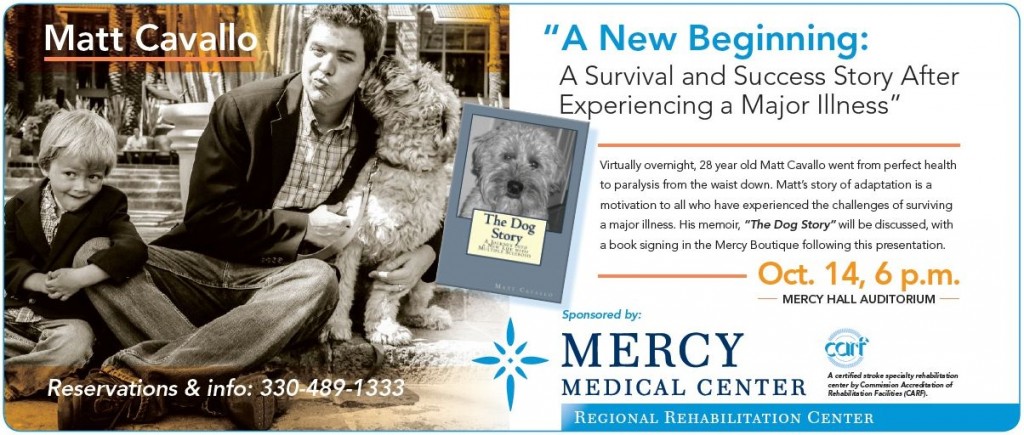
Matt Cavallo
Author, keynote speaker, healthcare leader, and storyteller. Twenty years with MS, turned into stories that move readers, audiences, and healthcare leaders alike.