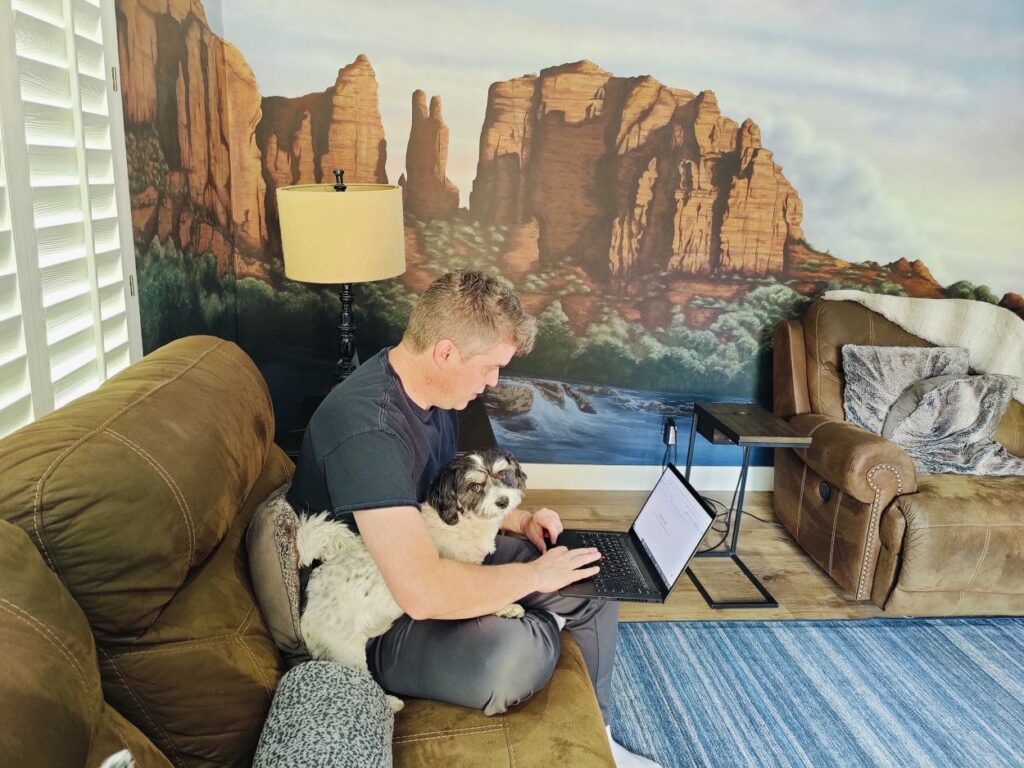
The Sedona Room is my writing oasis. An artist hand painted a sunrise over Cathedral Rock across the walls and ceiling, wrapping the room in warm desert hues, reds and oranges and blues stretching overhead while I sit with my feet kicked up on the couch, air conditioning humming, trying to make sense of fifteen years on a page. This is where the book actually got remade, not just the sentences, the whole shape of it.
My son Mason read the manuscript twice over one winter, and both times he came back with a note that changed the book. The first time, right after Christmas, he burst into the Sedona Room while I was reviewing agent pitches with Jocelyn. “You built these characters, you gave the hospital scenes all this weight, and then you race to the end,” he said. “Let the readers feel the fight.” He was right. I’d been protecting the reader from how bad the recovery actually was, skimming the hardest parts because writing them honestly meant reliving them. That note is the reason the USS Cole flashback exists, the reason the recovery scenes finally have teeth instead of a polished, abbreviated version of what happened.
I thought that was the big note. I thought I’d fixed the book.
A few weeks later Mason came back with a different question, and it landed harder than the first one. “You call this The Dog Story,” he said, “but Teddy barely shows up until the second half. Where’s the dog in the story?”
I didn’t have a good answer.
He was right, again. I had written a book about getting an MS diagnosis at twenty eight, with a dog folded in as a supporting character who arrives once the crisis is already underway. But that’s not actually the story. Teddy was there for fifteen years, not just the dramatic parts, the ordinary ones too, the two walks a day I promised him and kept even when I didn’t feel like keeping any promises to anyone, including myself. Mason’s question forced me to see that the book I’d written was structured around a diagnosis, when the book I actually needed to write was structured around a promise that outlasted it.
So I went back and pulled the entire manuscript apart again. Not sentence by sentence this time, chapter by chapter, timeline by timeline. Teddy needed to be present from the beginning, not summoned in once things got hard. The marriage needed more room too, not just the crisis version of Jocelyn and me holding on through hospital corridors, but the ordinary version, the version that got tested over and over across fifteen years in a hundred smaller ways nobody sees from the outside. Fatherhood needed the same treatment. Raising two boys while managing a chronic illness isn’t a subplot to the diagnosis, it’s its own fifteen year story running in parallel the whole time.
That’s the real shift Mason forced. This isn’t a book about surviving MS anymore, not really. MS is on every page it needs to be on, and it’s real, and I’m not softening any of it. But the actual spine of the book is a fifteen year promise to a dog, and everything else, the marriage, the fatherhood, the diagnosis itself, hangs off that one thread. You don’t get to understand what the promise cost unless you see the whole stretch of years it ran through, not just the worst of them.
If you’ve been reading this blog for a while, you’ve probably noticed some recurring names by now. Gerard shows up more than once, the guy who first told me to put my story out there, who saw the Spalding Gray in the way I talk. Mason shows up again and again too, not just as my son but as the sharpest editor I’ve had on this book, the one willing to walk into a room and tell his own father he’s holding back. That’s not an accident. This blog has become something like the visible seams of how the book actually got built, the actual conversations, the actual moments where somebody said something that cracked the manuscript open and made it better. I don’t know exactly who finds their way to posts like this one. Maybe it’s other writers mid-rewrite, staring at their own manuscript wondering if the structure is actually right. Maybe it’s people who’ve already read the book and want to know how it got made. Maybe it’s nobody yet, and that’s fine too.
But I think there’s value in leaving this trail. Someday, whether that’s a year from now or twenty, I think the people who care about The Dog Story will find their way back to this stretch of posts and see exactly how a seventeen year old with a sharp mind and no patience for a soft draft helped his father figure out what book he was actually writing. Let the readers feel the fight turned out to mean more than I thought it did when Mason first said it. It wasn’t just about not skimming the hospital scenes. It was about not skimming any of it, the whole fifteen years, the whole promise, the whole fight to keep showing up for someone every single day whether or not you felt like it that day.
Mason earned his writing credit twice over. Once for making the hospital scenes honest. Once for making me realize the book was never really about the hospital at all.

About the Author
Matt Cavallo
Author, keynote speaker, healthcare leader, and storyteller. Twenty years with MS, turned into stories that move readers, audiences, and healthcare leaders alike.