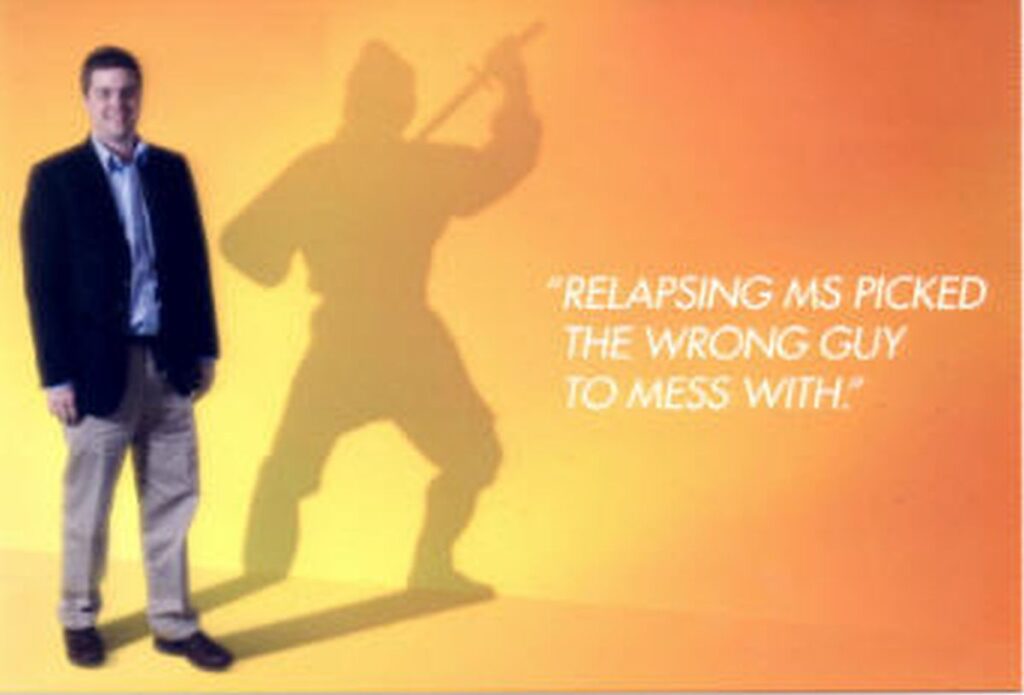
June 10th, 2005, I remember it like it was yesterday. This was the day that I had my follow-up visit with my neurologist. During the previous month, I had lost my ability to walk, been hospitalized and had been seeing a physical therapist to learn how to walk again all due to an acute onset of Transverse Myelitis.
This follow-up appointment was to let me know what the MRIs, CAT Scan and spinal tap taken at the hospital had revealed. I was making progress with therapy and was sure that at this visit, the doctor was going to give me a clean bill of health.
“Matt, come in. Sit down. I’m not going to pull any punches with you,” said my neurologist from his chair, leaning towards me.
I sat in my chair, anxiously awaiting his verdict.
“Matt, you have probable multiple sclerosis,” he said and then leaned back in his chair allowing me time to digest the gravity of his statement.
I paused for a second, stunned at his statement. “What do you mean probable multiple sclerosis?” I blurted out. “Do I probably have MS or probably not?”
Sensing my frustration he calmly responded, “Matt, what you experienced was a clinically isolated incidence of transverse myelitis. We won’t know whether or not it is multiple sclerosis until your next exacerbation.”
With that, I dropped my head and left my appointment in a deep depression. I didn’t know whether or not what I just experienced was the end of the road or if it was going to keep happening over and over again for the rest of my life.
Unfortunately, I am not alone. There are a lot of you reading this blog right now standing at this cross road wondering what to do. I wrote this for you and for Allison, who commented on my Optic Neuritis blog about having ON, but not MS.
This is a similar story to those who have been diagnosed with either Transverse Myelitis (TM), Optic Neuritis (ON) or Brainstem Syndrome (BS). Once you have received that initial diagnosis, there is an increased likelihood of developing MS, but it does not necessarily mean that you will.
My friends at MS Trust, provided a great CIS Fact Sheet. This CIS Fact Sheet, is easy to read and a great free resource to learn more about CIS, the likelihood of developing MS and treatment options. I would recommend that you print this out and use a resource for a conversation for either your doctor, family or friends concerned about your condition.
The National Center for Biotechnology Information (NCBI) produced a more technical study about the need for treatment and CIS. There is a lot of great clinical information in this report. This report can be confusing if you don’t have a background in Biotech. I am not a doctor, but my interpretation of this study is the recommendation is to start therapy early to reduce the risk of disease progression to MS. My advice would be to print this out and bring it to your appointment when discussing the need for treatment with your doctor.
The great news is that life is different for all of you going through CIS right now. From MRI studies to frontline treatment, there are a lot more options and research available for you now then just ten years ago when I was diagnosed. Whether you were like me and had TM, or one of the other CIS occurrences, there is hope that you won’t develop MS. There are also great resources like MS Trust and NCBI, where you can get great information. With these new tools available, your journey will be easier than mine.
Resources:
http://www.mstrust.org.uk/information/publications/factsheets/cis.jsp

About the Author
Matt Cavallo
Author, keynote speaker, healthcare leader, and storyteller. Twenty years with MS, turned into stories that move readers, audiences, and healthcare leaders alike.